Health Data & Field Operations
Beyond the Clinic Walls: How Health Data Powers Humanitarian & NGO Missions
From frontline community tally sheets to national DHIS2 indicators: why reliable public health interventions depend on trained data stewards in the field.
Ugwu Tochi Peace · 6 min read ·
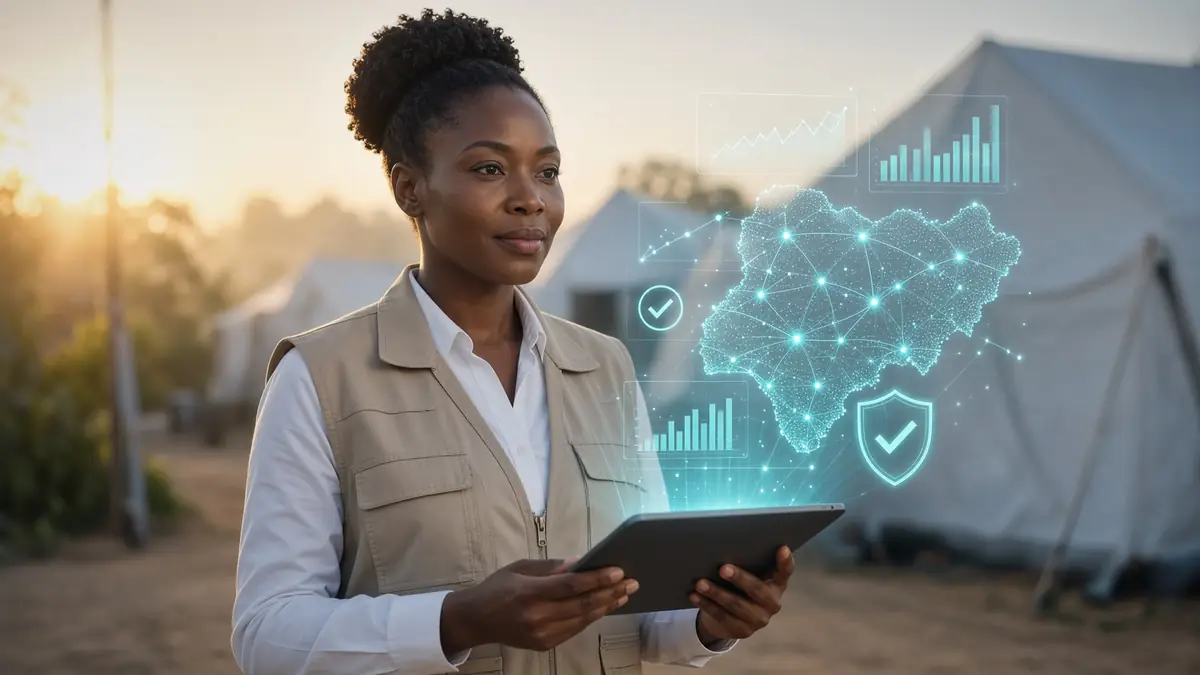
When a disease outbreak erupts in an informal settlement or an international NGO deploys a nutrition response to a displacement camp, the public sees the supply chains: emergency rations, cold boxes carrying vaccines, and clinical triage tents.
What remains invisible is the data pipeline deciding where those supplies go tomorrow morning.
Health data doesn't stop at the hospital. In humanitarian and NGO programmes, it moves through community workers, field teams, M&E officers, data officers, clinicians, digital platforms, and national reporting systems. Understanding how that information is collected, checked, and used is becoming an essential skill across the modern health workforce.
If your background is in traditional health information management (HIM) or clinical administration, you are accustomed to the quiet rhythm of the facility records department: pulling master patient indexes, managing folder archives, and filing discharge summaries. But step outside the hospital gates into donor-funded global health operations—backed by partners like USAID, UNICEF, or the Global Fund—and data collection becomes an active, multi-disciplinary field practice.
Here is how health data actually operates when clinic walls disappear.
1. The Paper Tally Reality at Primary Health Centers
A common myth in digital health is that international NGOs operate in purely paperless environments. On the ground, primary healthcare centers (PHCs) and mobile outreach units still rely heavily on physical registers, thick paper ledgers, and daily hash-mark tally sheets.
The breakdown rarely happens in software; it happens in the handoff.
Consider a routine immunization outreach day:
- A team of two community health extension workers immunizes dozens of infants under an open shelter.
- The paper tally sheet collects dirt, rain splatters, and rushed, hurried pen marks.
- At the end of the reporting cycle, those tallies must reconcile with the facility’s physical stock ledger (the number of empty vials discarded or returned).
A general database technician only looks at the monthly summary row entered into a computer. A trained health data specialist checks the operational link: If the monthly return reports 140 doses of Pentavalent vaccine administered, why does the stock register show only 110 doses were drawn from cold storage?
Catching that discrepancy at the facility gate prevents skewed coverage rates from traveling up the reporting chain.
2. Field Surveys Must Survive Zero-Connectivity Zones
When humanitarian teams run rapid baseline assessments or nutrition surveys, paper forms are often too slow to inform urgent program shifts. Waiting weeks to transcribe paper forms into a central spreadsheet can cause critical delays during an active outbreak or displacement surge.
To solve this, the sector relies heavily on mobile data tools built on the Open Data Kit standard, most commonly KoboToolbox.
Building a field-ready survey is not simple form typing; it requires structural discipline:
- Strict Logic Constraints: Writing validation logic so an enumerator cannot mistakenly log an infant’s age as 40 years, or record an antenatal visit for a male patient.
- Offline-First Functionality: Teams deploy to remote settlements without cellular network coverage. Forms must store data locally on mobile devices, cache GPS coordinates without exhausting battery reserves, and queue records for encrypted batch uploads once the vehicle returns to cellular range.
- Audit Logs: Activating background timestamp audits to verify how long an enumerator actually spent completing a household questionnaire, catching rushed or incomplete submissions before analysis begins.
3. The Audit Defense: Routine Data Quality Assessments (RDQA)
- 1. Frontline Paper Tally
- 2. Kobo Mobile Survey
- 3. RDQA Audit
- 4. DHIS2 / Donor Indicator
In global health, unverified data can quickly become a serious reporting and funding risk. Major grants rely on clear accountability to justify continued operational support.
Monitoring and Evaluation (M&E) teams and health data officers verify facility metrics through a Routine Data Quality Assessment (RDQA). This is a structured verification trace:
- The Primary Source: Manually counting individual client entries line-by-line across the physical clinic attendance register.
- The Collation Step: Verifying that the monthly facility summary form accurately reflects the ledger total without double-counting return visits.
- The System Verification: Logging into DHIS2 (District Health Information Software) to confirm the aggregated digital indicator mirrors the verified facility audit.
When health professionals conduct an RDQA, the goal is not punitive policing. It is practical health system strengthening: identifying transcription fatigue, training facility in-charges on tally standards, and making sure regional health decisions rely on verifiable ground truth.
4. Why NGOs Need Health Data Professionals, Not Just General IT
Humanitarian and public health programs routinely encounter challenges when hiring generalist IT technicians to manage health data portfolios. The databases run smoothly, but the information inside them can lack clinical and epidemiological context.
General IT personnel rarely have training in:
- Why tracking unique client identifiers across separate HIV/TB registers is critical to prevent loss to follow-up.
- How diagnostic coding (ICD classifications) impacts disease surveillance accuracy.
- The legal and ethical boundaries of patient confidentiality during community tracing.
On the other side, frontline clinicians (nurses, community health officers, doctors) are fully consumed by patient care. They cannot spend hours troubleshooting duplicate entries in an aggregate indicator table.
This is why programs need dedicated health data professionals. This workforce includes Health Information Management (HIM) specialists, M&E officers, health data analysts, and digital health practitioners. These professionals understand medical terminology, clinical ethics, and documentation standards—while commanding the technical field tools (KoboToolbox, DHIS2, Excel, and Power BI) required to keep global health operations accountable.

HIMForward Masterclass Preview: How Field Health Data Flows
Video lecture series launching soon with our NGO Track
The Career Opportunity: Bridging the Divide
Transitioning into field health informatics, M&E, or health data analytics is not about discarding your foundational healthcare training. It is about taking your governance principles into dynamic environments where rapid decisions dictate community outcomes.
Whether your background is in health records, clinical documentation, nursing, or health administration, mastering routine data audits, field survey architecture, and indicator reporting equips you with a versatile, future-proof skillset.
By learning how health information flows from frontline paper registers into national digital systems, you position yourself as a vital data steward across global health, humanitarian operations, and the wider digital health landscape.
Interested in health data workflows, routine M&E, and field tools? Explore our open curriculum.