HIM Career Development
From Clinic Records to Field M&E: 4 Digital Tools Every Health Information Management Professional Should Learn
Ugwu Tochi Peace · 5 min read ·

A practical look at KoboToolbox, DHIS2, Excel, and Power BI for HIM professionals moving into digital health, public health data, and field monitoring and evaluation.
For decades, the standard perception of Health Information Management (HIM) has been tied to the physical hospital records department: color-coded folders, paper registers, shelf filing, and manual clinic retrievals.
While the fundamental principles of health data governance, patient privacy, and clinical documentation remain as vital as ever, the landscape of global health delivery has changed. Today, international NGOs, humanitarian agencies, and public health initiatives increasingly rely on digital systems to collect, manage, analyze, and visualize data for decision-making.
For HIM professionals, health records officers, and digital health practitioners looking to transition into Monitoring and Evaluation (M&E) and public health informatics, mastering clinical terminology is no longer enough. You also need an applied technical toolkit for collecting, validating, cleaning, analyzing, and visualizing health data.
Here are four essential tools every forward-thinking health data professional should learn:
1. KoboToolbox / ODK (Open Data Kit)
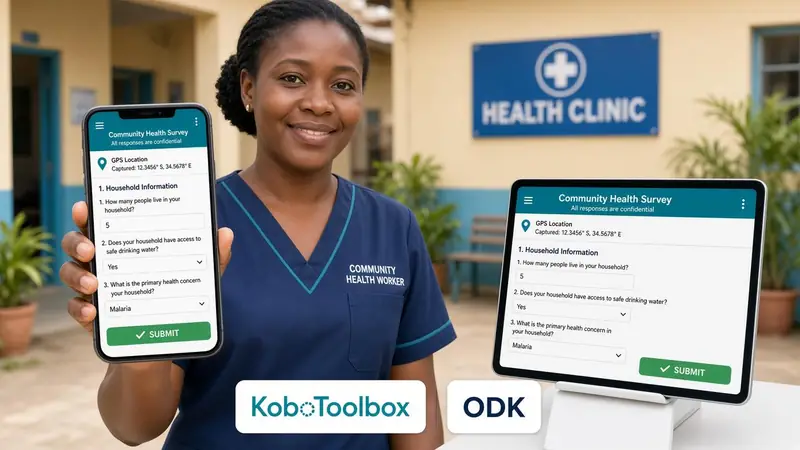
In humanitarian relief operations, community health outreaches, surveys, and field programs, paper forms can be slow, difficult to manage, prone to physical loss, and costly to transcribe.
WHY IT MATTERS
KoboToolbox and ODK-based workflows are widely used for digital data collection in humanitarian, development, research, and public health settings. They allow field teams to deploy structured digital forms on phones and tablets, including in environments where internet connectivity is limited or unavailable.
KEY SKILLS TO BUILD
- Designing digital survey forms using XLSForm.
- Creating skip logic, constraints, calculations, and relevant validation rules.
- Configuring GPS location, timestamps, and other field-verification features.
- Managing form submissions and exporting datasets for cleaning and analysis.
- Understanding offline data collection workflows.
2. DHIS2 (District Health Information Software 2)
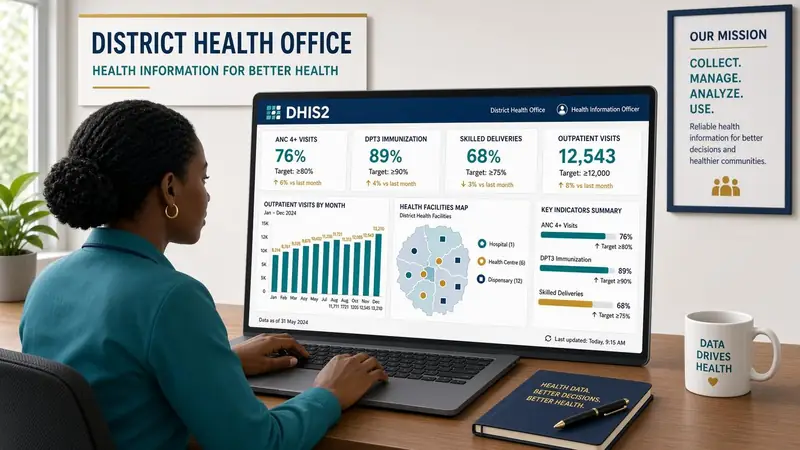
If digital data-collection platforms support primary field data collection, DHIS2 plays a major role in routine health information management and population-level health reporting.
WHY IT MATTERS
DHIS2 is used by health systems and health programs in many countries to collect, aggregate, analyze, and visualize routine health information. Learning DHIS2 helps HIM professionals move from managing individual patient records toward understanding facility-level and population-level health trends.
KEY SKILLS TO BUILD
- Navigating aggregate data-entry workflows.
- Understanding datasets, indicators, data elements, and reporting periods.
- Validating routine health reports.
- Supporting Routine Data Quality Assessments (RDQAs).
- Identifying discrepancies between source documents and submitted digital reports.
- Building and interpreting basic visualizations and public health indicators.
KoboToolbox
Offline Field Capture
DHIS2
Aggregate Health Trends
Advanced Excel
Data Cleaning & Audits
Power BI
Program Dashboards
3. Advanced Microsoft Excel for Health Data Workflows
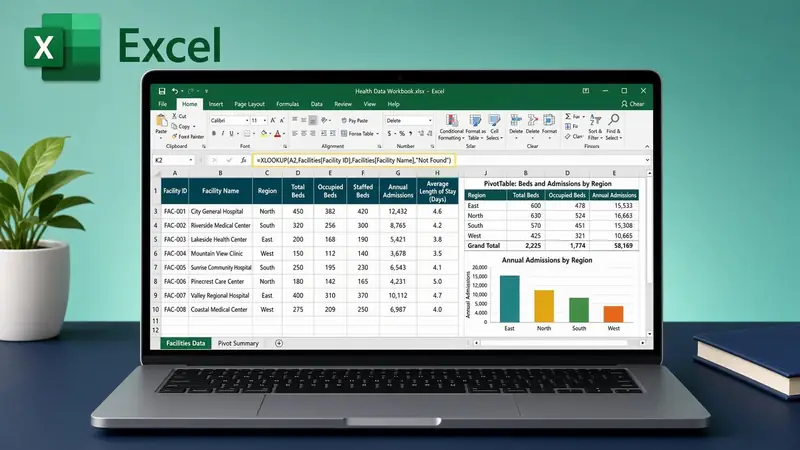
Basic data entry is only one part of health information work. Advanced Excel skills can be extremely valuable for cleaning, reconciling, analyzing, and reporting health datasets.
WHY IT MATTERS
Before a dataset can be used for program reporting, imported into another system, or presented to decision-makers, it often needs to be cleaned, checked, reconciled, and analyzed. Excel remains a practical tool for many health information and M&E workflows.
KEY SKILLS TO BUILD
- Lookup functions such as XLOOKUP.
- Sorting, filtering, and data-cleaning techniques.
- Removing duplicates and identifying missing or inconsistent values.
- Pivot tables for facility and program summaries.
- Data validation and error-prevention techniques.
- Basic descriptive statistics and percentage calculations.
- Creating charts that communicate health trends clearly.
4. Microsoft Power BI (or Looker Studio)
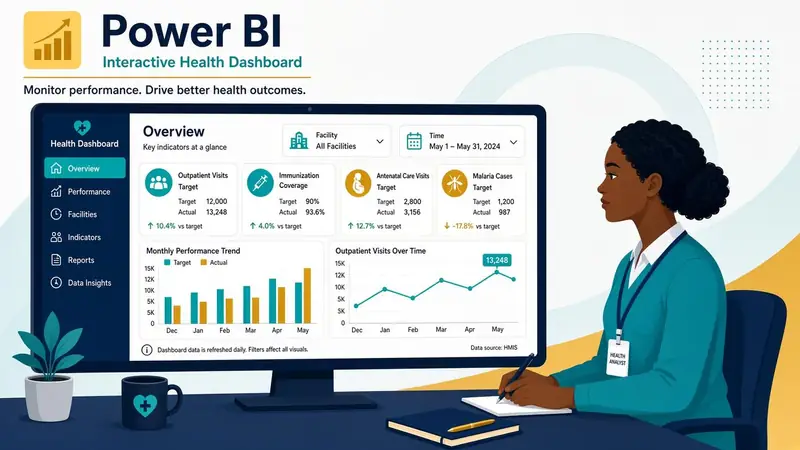
Raw numbers in a spreadsheet do not automatically communicate impact. Decision-makers need information presented in a way that makes trends, gaps, and performance easy to understand.
WHY IT MATTERS
Business intelligence tools such as Power BI can transform large datasets into interactive dashboards. For an HIM professional, learning how to turn health data into a clear dashboard can demonstrate analytical ability and support better decision-making.
KEY SKILLS TO BUILD
- Connecting Excel and CSV datasets to a dashboard.
- Cleaning and preparing data for visualization.
- Creating indicator cards such as Target vs. Actual.
- Building charts that communicate health-program trends.
- Creating filters for time periods, facilities, regions, and other relevant dimensions.
- Designing simple dashboards for program monitoring and reporting.
The Road Ahead: Evolving Your Career
The future of Health Information Management is not limited to the traditional records department.
By combining a strong foundation in health information management with practical digital tools such as KoboToolbox, DHIS2, Excel, and Power BI, HIM professionals can begin exploring opportunities across health data management, Monitoring and Evaluation, public health informatics, digital health, research, humanitarian programs, and NGO operations.
You do not have to abandon your HIM foundation to enter these areas. Instead, you can build on what you already know.
Your understanding of health records, clinical documentation, data quality, confidentiality, coding, and health information systems is a valuable starting point.
The next step is learning how to apply those skills to larger datasets, digital systems, field programs, and population-level health questions.
Start Building Your Digital Health Skills
At HIMForward, our goal is to make practical health information, digital health, data, and career-development skills more accessible to aspiring healthcare and health information professionals across Africa and emerging health systems.
Explore the HIMForward learning resources and continue building the skills that can take your career from clinic records to digital health and field M&E.