Health Policy & Health Informatics
Data-Driven Health Policy: Why Better Health Decisions Must Start at the Facility Level
Ugwu Tochi Peace | Founder, HIMForward | Health Information Management Professional
- Health Policy
- Health Information Management
- Digital Health
- Health Data Quality
- DHIS2
- Public Health
- Nigeria

The Problem May Not Be Where We Think It Is
Imagine a busy primary healthcare centre in southeastern Nigeria.
It is Thursday afternoon, and the maternal and child health unit is crowded. Mothers have come for antenatal care, immunisation, and other essential services. Nurses move between patients, health workers update registers, and the facility's limited resources are stretched.
At the end of the month, someone must count the entries in the registers and transfer the figures into summary forms for reporting.
It is a demanding task. A missed tally mark, an incorrect figure, or a simple calculation error can change the final report.
The figures eventually reach the state level and are entered into the District Health Information Software 2 (DHIS2), a digital platform used by many health systems to collect and analyse routine health data.
Months later, policymakers review a dashboard showing a decline in immunisation coverage in the area.
They conclude that parents may not be taking their children for vaccination. A new community awareness campaign is proposed, and money is allocated to encourage more parents to visit health facilities.
But there is a problem.
What if the facility had run out of vaccines? What if the number reported was incorrect? What if the mothers came for immunisation but could not receive the service?
The real problem might not be a lack of awareness. It might be a shortage of supplies, a reporting error, or a combination of both.
Yet the decision has already been made based on the figures available.
This is one of the biggest challenges in health policy: decisions can only be as good as the information used to make them.
1. From the Health Facility to the Government's Decision-Making Table
Health policies are designed to solve important problems. Governments develop strategies to reduce maternal deaths, improve immunisation coverage, control infectious diseases, and make healthcare more accessible.
These goals are important. However, achieving them requires more than good intentions, funding, and well-written policy documents.
It requires reliable information about what is actually happening in health facilities and communities.
Consider the journey of a simple immunisation record.
A health worker vaccinates a child and records the service in a register. At the end of the reporting period, the information is counted and transferred to a summary form. The figures are submitted, entered into a digital reporting system, and eventually included in reports used by health managers and policymakers.
At every stage, the information must be recorded, checked, and transferred correctly.
If an error occurs at the beginning, it can travel through the entire reporting process. By the time the figures appear on a national dashboard, it may be difficult to identify where the problem started.
This is why health information management matters.
Health Information Management (HIM) professionals help ensure that health information is properly documented, organised, validated, protected, and made available for decision-making.
Their work connects what happens in a consultation room or health facility to the decisions made at local, state, and national levels.
Without that connection, policymakers may see the numbers without fully understanding the reality behind them.

2. When Poor Data Leads to Poor Decisions
Health data is not just about counting patients or completing monthly reports. It influences how healthcare resources are distributed and which problems receive attention.
When the information is incomplete, inaccurate, or delayed, the consequences can be serious.
Resources may go to the wrong places
Imagine two local government areas.
The first reports high demand for vaccines, while the second reports low demand. Based on these figures, more vaccines may be sent to the first area and fewer to the second.
But what if the second area has been reporting fewer vaccinations because its facility records are incomplete? Or because health workers have not been submitting their reports on time?
The allocation may not reflect the actual needs of the population.
Similar problems can affect medicines, diagnostic supplies, equipment, and staff deployment.
Reliable data helps health managers understand where services are needed most and plan accordingly.
The real cause of a health problem may be overlooked
Suppose a health facility reports a decline in antenatal clinic attendance.
A policymaker might assume that pregnant women are not interested in antenatal care and introduce a public awareness campaign.
However, the actual reasons might include transport difficulties, long waiting times, staff shortages, or a lack of essential supplies.
The numbers show that attendance has declined, but they do not automatically explain why.
Good health information management helps ensure that figures are checked against source records and interpreted alongside the realities of healthcare delivery.
Data tells us what may be happening. Careful analysis helps us understand why.
Funding and accountability may suffer
Governments and development partners need evidence that health programmes are reaching the people they are intended to serve.
Organisations such as the Global Fund, UNICEF, and the United States Agency for International Development (USAID) use programme data and other forms of evidence to assess activities, monitor progress, and evaluate results.
When reported figures cannot be reconciled with the original records, questions arise about data quality and programme performance.
This can lead to additional verification exercises, delays in reporting, reduced confidence in the results, and difficulties demonstrating the value of investments.
It is important to note that a data discrepancy does not automatically mean funding will be withdrawn. However, persistent problems with data quality can weaken confidence in a programme and make accountability more difficult.
Reliable health information is therefore important not only for planning services but also for demonstrating results and maintaining trust.
3. The Problem Often Begins at the Point of Data Collection
When people discuss health data challenges, they often focus on national databases, dashboards, and digital technology.
But many problems begin much earlier.
They begin when a patient encounter is poorly documented, when a register is incomplete, when figures are counted incorrectly, or when reports are submitted without proper verification.
Consider the workload of a nurse in a busy health facility. In addition to caring for patients, the nurse may need to complete several registers and tally sheets before preparing monthly reports.
Under pressure, mistakes can happen.
A figure may be entered incorrectly. A service may be recorded in one register but omitted from a summary. Two reports may contain different totals for the same reporting period.
These errors do not necessarily mean that health workers are careless. They may reflect heavy workloads, inadequate training, limited equipment, unclear reporting procedures, or poorly designed systems.
That distinction matters.
If we blame individuals without addressing the conditions in which they work, the same problems are likely to continue.
Health facilities need practical systems that make accurate documentation easier, routine verification possible, and reporting more manageable.
Technology can help, but it cannot solve every problem on its own. A digital system will not automatically produce reliable information if the original records are incomplete or the people using it have not received adequate training.
The goal must be to improve the entire process, from the first entry to the final report.
4. How Can We Close the Gap Between Health Data and Health Policy?
Improving health policy requires more than introducing another reporting platform. It requires strengthening the people, processes, and systems responsible for producing reliable information.
Here are four practical steps that can make a difference:
First, check the figures before submitting reports
Health facilities should routinely compare their monthly summaries with the original registers and tally sheets.
For example, if a monthly report records 120 immunisation visits but the source documents support only 95, the discrepancy should be investigated before submission.
Routine Data Quality Assessments (RDQAs) and other verification procedures can help facilities identify missing information, inconsistent figures, and reporting errors.
The purpose is not simply to find mistakes. It is to understand why they occurred and prevent them from happening again.
Data quality checks should become part of normal facility operations rather than an activity reserved for external inspections.
Second, use digital tools to improve reporting
Digital tools can make health information collection, analysis, and reporting more efficient when they are properly implemented.
For example:
- KoboToolbox can support structured mobile data collection, particularly during community assessments and field surveys.
- DHIS2 can support the collection, aggregation, analysis, and reporting of routine health data.
- Microsoft Excel can help health workers organise records, check figures, and identify inconsistencies.
- Power BI can turn suitable datasets into visual dashboards that help health managers identify patterns and monitor performance.
These tools serve different purposes, but they can contribute to a stronger health information system when their use is properly coordinated.
Imagine a local health manager reviewing a dashboard that shows a decline in childhood immunisation.
Instead of immediately concluding that parents are refusing vaccination, the manager can investigate the facility records, review vaccine availability, compare reporting periods, and speak with the relevant health workers.
The dashboard becomes a starting point for investigation rather than the final answer.
That is the real value of digital health tools: they can help people ask better questions and make more informed decisions.
Third, give Health Information Management professionals a stronger role
HIM professionals should not be seen only as staff responsible for retrieving patient folders, filing documents, or submitting monthly reports.
Their expertise is relevant to data quality, clinical documentation, coding, information governance, reporting processes, and the responsible use of health information.
They can work with nurses, doctors, public health officers, data managers, and facility administrators to identify documentation gaps, verify reported figures, and improve information workflows.
For example, when immunisation figures do not match the original records, an HIM professional can help trace the discrepancy, review the documentation process, and recommend practical corrective measures.
When a facility introduces an electronic health record system, HIM professionals can also contribute to data standards, documentation procedures, and the quality of information captured.
This is how HIM moves beyond routine administration and becomes an active part of healthcare quality improvement and policy implementation.
Fourth, connect the data to the decisions that follow
Collecting accurate data is only part of the job. Health managers must also use it to make decisions and assess whether those decisions are working.
If a facility reports low antenatal attendance, managers should investigate possible causes before choosing an intervention.
If a district reports a decline in immunisation, they should examine the quality of the data, vaccine availability, staffing, access to services, and other relevant factors.
After an intervention is introduced, the same information systems should help managers monitor progress and determine whether the situation has improved.
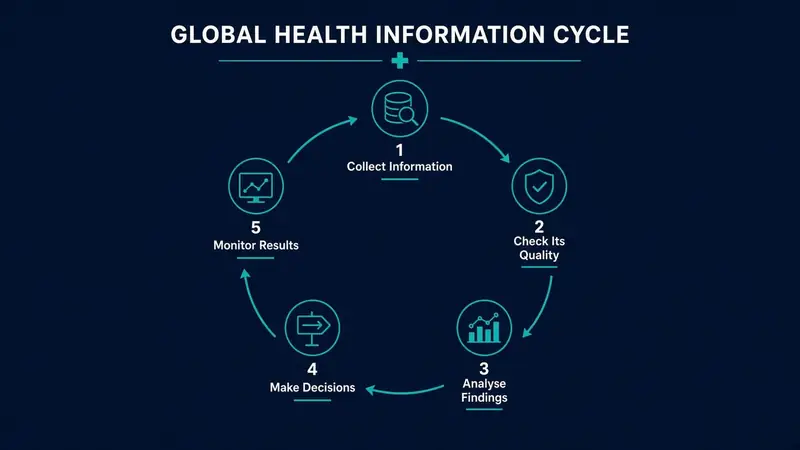
This creates a continuous cycle:
- 1. Collect information
- 2. Check its quality
- 3. Analyse the findings
- 4. Make decisions
- 5. Monitor the results
When this cycle works well, health information becomes more than a reporting requirement. It becomes a practical tool for improving healthcare delivery.
5. Health Policy Must Reflect What Happens on the Ground
National health strategies are often developed far from the communities they are intended to serve.
Policymakers may review national reports, attend planning meetings, consult technical experts, and study dashboards before deciding where resources should go.
These activities are necessary. However, national figures must remain connected to the realities of individual health facilities and the people who depend on them.
A national report may show that immunisation coverage is falling. Facility-level information may reveal that the decline is concentrated in communities experiencing vaccine shortages.
A maternal health report may indicate poor service utilisation. Further investigation may reveal long waiting times, transport barriers, or gaps in staffing.
Without reliable facility-level information, these differences can remain hidden behind national averages.
This is why effective health policy needs both accurate data and a clear understanding of the circumstances behind it.
Digital dashboards can reveal patterns, but frontline verification and local knowledge help explain them.
Neither should replace the other.
The strongest decisions emerge when reliable data, professional expertise, and the experiences of healthcare workers and communities are considered together.
The Way Forward: Make Health Information a Strategic Priority
Across Nigeria and other countries in sub-Saharan Africa, health systems continue to pursue digital transformation, stronger primary healthcare, better disease surveillance, and progress towards Universal Health Coverage.
Achieving these goals requires more than buying computers, installing software, or launching new reporting platforms.
It requires investment in the foundations of a reliable health information system.
Health workers need appropriate tools and manageable documentation processes. Facilities need clear reporting standards and regular data quality checks. Managers need the skills to interpret information correctly. HIM professionals need opportunities to contribute to analysis, digital transformation, and decision-making.
Governments and development partners should also recognise that data quality is not merely a technical responsibility. It is a shared institutional responsibility that affects planning, service delivery, resource allocation, and accountability.
Most importantly, health facilities should receive feedback on the information they submit. Data collection should not end when a report reaches the next administrative level. Facilities need to understand what the findings mean, what problems have been identified, and what actions should follow.
This is how the gap between frontline healthcare and national policy can begin to close.
Final Thoughts
A national health policy may be written in a ministerial office, but its success depends on what happens in health facilities and communities across the country.
A missed entry in a register may seem insignificant. An incorrect monthly total may appear to be a minor administrative problem. But when such errors accumulate, they can affect the information used to allocate resources, evaluate programmes, and set public health priorities.
The solution is not to collect more data simply for the sake of reporting. It is to ensure that the information collected is accurate, meaningful, timely, and useful.
For Health Information Management professionals, this presents an opportunity to play a greater role in shaping healthcare delivery and public policy.
Our responsibility extends beyond managing records. It includes helping health systems understand what their information is telling them, identifying where that information may be unreliable, and ensuring that decisions are grounded in evidence.
If we want better health policies, we must start by improving the information on which those policies depend. And that work begins at the facility level.
About the Author
Ugwu Tochi Peace is a Health Information Management professional and the Founder of HIMForward, a learning platform focused on advancing Health Information Management, digital health, and practical data skills for health information professionals.
Through HIMForward, she advocates for stronger health information systems and the meaningful use of reliable data to support healthcare delivery and decision-making.
HIMForward.com | Building the future of Health Information Management.